
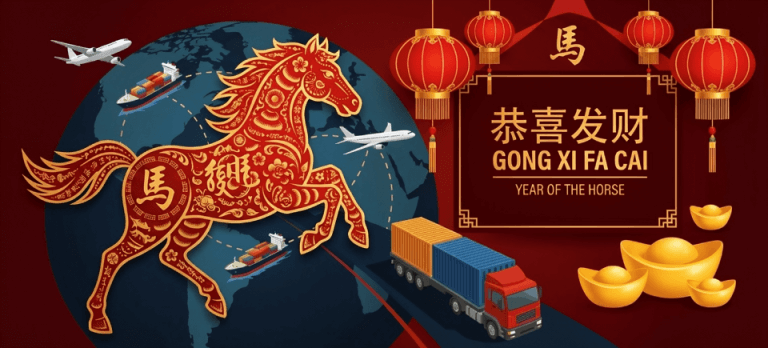
On 17th January 2026, over a billion people across China, South Korea, Vietnam, and communities worldwide welcomed the Year of the Horse. Lunar New Year is the single biggest cultural event on the Chinese calendars. A multi-week celebration that brings factories, ports, freight offices, and logistics networks to a near-complete standstill. For UK businesses shipping goods to or from these regions, it is one of the most disruptive, and most predictable event in the global trade calendar.
Horse is a symbol of energy, momentum, and forward movement
So what does the Horse mean for trade? In Chinese astrology, the Horse is a symbol of energy, momentum, and forward movement. It is associated with boldness, ambition, and a willingness to break new ground. For international traders, that’s an encouraging omen. The Horse year traditionally signals dynamic commercial activity, rapid decision-making, and an appetite for new partnerships. All qualities that bode well for UK exporters looking to grow their presence in Asian markets, and for UK importers seeking to strengthen supply relationships with Chinese and Korean manufacturers. If the Horse’s energy holds true, 2026 could be a year where new trade lanes open and long-stalled deals finally get moving.
Plan early or pay the price
But first, you have to survive the Golden Week. The practical reality of Lunar New Year for any UK business with a China supply chain is this: plan early or pay the price. Chinese factories typically close for two to four weeks around the New Year period, longer than the official public holiday, as migrant workers return to their home provinces. Korean businesses observe a shorter but equally significant holiday known as Seollal. The knock-on effects for UK import shipments are significant: container space fills up fast in the weeks before the holiday as manufacturers rush to clear orders, freight rates spike sharply, and lead times stretch considerably in the weeks after factories reopen as production backlogs clear. If your business depends on goods manufactured in China or Korea, the disruption doesn’t end when the fireworks do.
What does this mean for your shipping schedule right now? If you’re a UK importer expecting goods from China in February or March, your shipment has almost certainly been affected. Post-holiday factory restart periods typically run through late February into March, and ocean freight capacity from major Chinese ports: Shanghai, Ningbo, Shenzhen – remains tight as the backlog clears. UK exporters shipping goods into China should also be aware that Chinese customs clearance and distribution networks run at reduced capacity during and immediately after the holiday period, meaning even goods that have physically arrived in China can sit waiting for processing. The key is communication: confirming production status, booking freight early, and building buffer stock into your planning are non-negotiable disciplines for any business trading in this part of the world.
Kinnes Shipping: Your Partner for UK-China Trade
At Kinnes Shipping, we help UK businesses navigate the complexities of importing and exporting goods across Asia. From managing Lunar New Year disruption to handling customs documentation, freight bookings, and end-to-end logistics between the UK and key markets including China, South Korea, and beyond. Whether you’re a retailer sourcing products from a Chinese manufacturer, an engineering firm exporting components to Seoul, or a food and drink brand looking to crack the Asian market, we bring the expertise and relationships to keep your supply chain moving – whatever the year has in store.
Ready to move goods to or from China? Get in touch with the Kinnes Shipping team today and let’s make the Year of the Horse work for your business.