
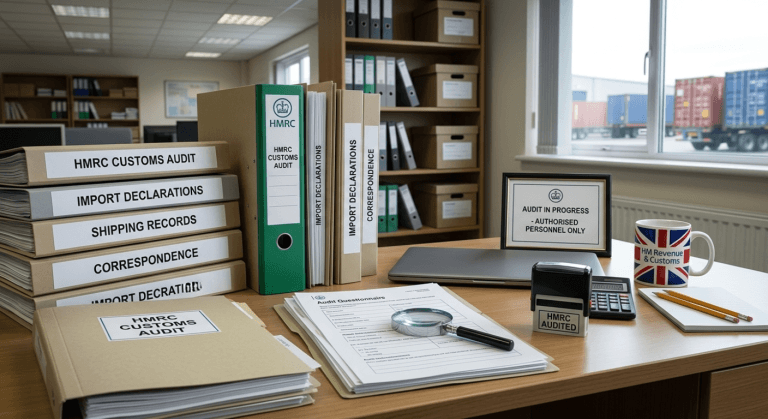
HMRC Customs Audit frequencies are increasing as we hear from more and more clients who have received notice from HMRC. It’s anticipated these will increase in the coming years.
If your business has not had an audit since procedures were introduced by the UK Government after Brexit then the chances of an audit increase each year. Prevention is better than a cure
Keep good document hygiene
Ideally you want to keep things clean and organised. An unstructured, messy filing system is going to make compliance a nightmare. I’ve seen documents managed by customs agents on Teams, some manage it in email folders or worse – relying on emails alone as evidence. These aren’t enough. A strong, well formatted filing system is a must.
Create a Customs Instruction Sheet
When requesting customs clearance, it is highly recommended to create a simple Customs Instruction sheet to give to your customs agent for them to follow. There are a number of reasons for this such as :
- Your customs agent is most likely a direct representative and must submit information to HMRC, as instructed so they will need one for their compliance.
- You should have evidence of your instruction to your agent, so you can show HMRC during an audit. If the agent does not comply with your instruction, you can evidence this.
For each customs entry, you will need to store all the documents, including a copy of the customs entry within a folder. How you structure your folders is up to you but the main takeaway should be that you should file documents in a good, clean structure that makes finding documents easy. YEAR / INVOICE|PO NUMBER or YEAR / SUPPLIER / INVOICE|PO NUMBER is generally good enough. You should store the documents for a minimum of 4 years.
Avoid AI
This is a personal recommendation – avoid the use of generative large language models (LLMs) in environments that need accuracy. Things like gemini, gpt, deepseek, mistral and claude make things up by their very nature. Their ‘guess the next token‘ design could create issues for your data integrity, file structure and internal compliance.
Embed Good Governance
Good governance can mitigate issues before they become a problem.
- Prepare customs instructions sheets for your agent.
- Review the clearance immediately once received.
- Record and file issues that arise (inspections/holds at border)
- Conduct monthly internal audits.
- Give feedback to your customs agent in review sessions and follow-up to ensure errors are resolved for future.
Internal audits can pick up issues before they become systemic within the business. A 10% check, every month is all that is required. Simply throw together an excel spreadsheet with a number of key headings to verify during your checks, such as :
- Date of entry, reference, MRN.
- Exporter
- Gross weight
- Currency and value
- Unit ID
- Item :: CPC (Customs Procedure Code)
- Item :: Commodity code
- Item :: Preference code (If using preferential rates of duty – record why you are entitled to this)
- Item :: Document codes
- Item :: Vat and duty payment methods
Take control of your customs – don’t leave compliance to an agent.
Too often we see traders sending documents without instruction. Leaving agents to try and decipher the correct information to extract from documents and blurring the lines between direct and in-direct representation. This opens up a risk within both the customs agents business, and the trader. The customs agent is leaving to far over to in-direct and risks liability in the case where incorrect data is extracted and, the trader has no control over what is being submitted – despite ultimately being responsible and liable for all information.
Simple fix – Issue a customs instruction sheet to your agent. Tell them exactly what you want them to do for you.
You’ll find that by issuing a customs instruction sheet to an agent, that your clearances will be more accurate and, (should be) issued quicker.
In addition to this, we encourage traders to sign up to the UK Government’s CDS Subscription Service.
Once subscribed, you can request customs reports from the HMRC Trade Reporting and Extracting Service (sometimes referred to as TRE) for review.
Preparing for an audit
Embrace audits.
If you are in fear of an audit then it suggests you have a low confidence in your data, procedures and processes. HMRC can, if they deem it nessesary, issue £2,500 per mis-declared data element for serious breaches, or typically £1,000 for low risk. In extreme cases, criminal proceedings can be taken against the person responsible (usually CEO or owner), leading to large fines or prison sentences.
When conducting your internal review, focus heavily on commodity code, country of origin, duty and vat –
- Does the clearance have the correct commodity code?
- Does the clearance have the correct country of origin?
- Is it the correct item value listed?
- Did you correctly claim preferential rates?
- Have you incorrectly used VATZ/VATE?
HMRC care about the money. You must ensure you have given them their share, and it is the correct amount – to the penny. They will not give you a free pass because you forgot to pay a couple of pennies in duty or tax.
While the above sounds scary and that the big bullies of HMRC are going to destroy you over an underpaid vat bill of 10 pence, in reality it’s not that bad. Audits can be a learning experience to better understand holes in your processes that you may have missed. The best way to prepare for an audit is to:
- Take control of your customs process
- Ensure you issue an “instruction” sheet for every shipment
- Employ a responsive and capable customs agent – make sure you can discuss concerns freely with your agent. If you don’t have an agent or are considering switching, get in touch.