
When arranging an international shipment, there are plenty of details to get right. For example, commodity, weights and dimensions, shipping instructions, customs information, ports, dates and delivery requirements.
One field that can sometimes be overlooked is the Place of Delivery shown on the Bill of Lading.
It is a simple administrative detail, but selecting the wrong location can result in additional charges, delays and unnecessary amendments to your shipping documentation.
We have had an example where a customer selected Edinburgh as the Place of Delivery, only to discover that the shipment had to be booked on a merchant haulage basis due to delivery issues. Correcting the Bill of Lading after issuance resulted in an amendment charge of $350!
This is a good example of why checking the Place of Delivery before submitting your shipping instructions is important.
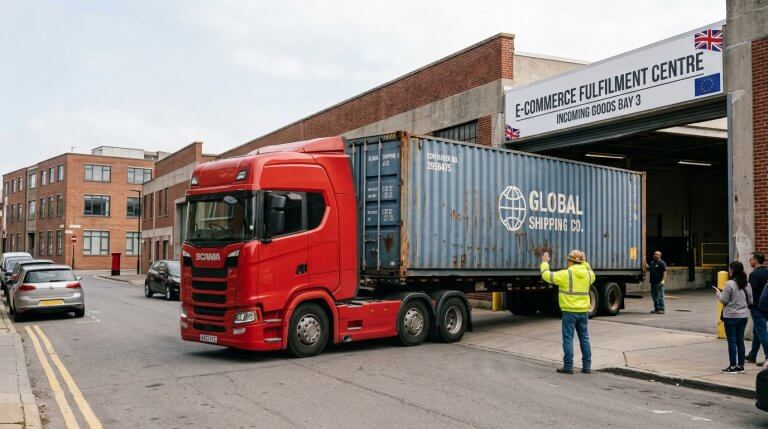
If you are planning on using carrier haulage or merchant haulage, always make sure you have everything in place to empty your container.
- Do you have lifting equipment?
- Do you have a loading bay?
- Do you have enough people to help unload?
Shipping lines and hauliers have free unloading time before charging so double check this too when make a booking.
What is the Place of Delivery on a Bill of Lading?
The Place of Delivery determines where the carrier is contracted to hand the goods over to the consignee or its agent.
It is different from the Port of Discharge.
For example: Shanghai → Felixstowe → Edinburgh
- Port of Loading: Shanghai
- Port of Discharge: Felixstowe
- Place of Delivery: Edinburgh — if the shipping line is contracted to arrange the inland movement to Edinburgh
If the customer is arranging the inland transport, the situation is a little different. This is merchant haulage.
Why does this matter?
The Place of Delivery is not simply where the customer wants the cargo to go. It needs to reflect the transport arrangement that has actually been arranged.
Getting this wrong can create problems with:
- Bill of Lading amendments
- Additional carrier charges
- Inland transport arrangements
- Delivery instructions
- Documentation
- Customs and clearance processes
- Letters of credit and documentary requirements
- Responsibility for the cargo after discharge
In some cases, an amendment may be relatively straightforward. In others, it can involve operational delays and more money.
A real-world example: Let us use Edinburgh again.
Imagine a shipment is moving:
China → Port of Felixstowe → Edinburgh
The consignee is arranging the road transport from Felixstowe to Edinburgh themselves. This is merchant haulage for the inland delivery from the Port of Felixstowe to Edinburgh.
If the shipping instructions are submitted showing:
Place of Delivery: Edinburgh
the shipping line may interpret this as a request for the carrier to provide the inland movement to Edinburgh.
If the booking was actually intended to be merchant haulage, the appropriate Place of Delivery may instead need to be the Port of Discharge/terminal at Felixstowe, with the customer arranging the onward movement themselves.
If the Bill of Lading has already been issued with Edinburgh as the Place of Delivery, changing it can incur an amendment fee.
In our example, the customer was faced with a $350 amendment charge simply because the Place of Delivery had not matched the agreed haulage arrangement. That was an avoidable cost that can often be prevented at the shipping-instruction stage.
Merchant haulage vs carrier haulage. What is the difference?
Booking merchant haulage, the customer or their appointed transport provider arranges the inland movement.
For example:
Port of Felixstowe → Edinburgh
The customer arranges the truck to collect the container from Felixstowe and deliver it to Edinburgh.
In this situation, the shipping line’s contracted movement may end at the port/terminal, rather than Edinburgh.
Therefore, when preparing the Bill of Lading instructions, the Port of Discharge should generally be reflected as the Place of Delivery where that is the carrier’s contractual delivery point, subject to the particular carrier’s booking terms and documentation requirements.
Carrier haulage
Under carrier haulage, the shipping line arranges the inland movement as part of the booked service.
For example: Shanghai → Felixstowe → Edinburgh
The shipping line arranges the movement from Felixstowe to Edinburgh. In that situation, Edinburgh can be the appropriate Place of Delivery, because the carrier has contracted to deliver the cargo there.
What if the customer wants delivery to the inland location?
That’s where carrier haulage comes in. If the customer requires the shipping line to arrange the inland transport, the booking should be made accordingly.
For example:
Port of Discharge: Felixstowe
Place of Delivery: Edinburgh
Haulage: Carrier haulage
This tells the carrier that the contracted service includes the inland movement to Edinburgh.
By contrast:
Port of Discharge: Felixstowe
Place of Delivery: Felixstowe
Haulage: Merchant haulage
This would indicate that the customer is responsible for arranging the onward movement. The exact terminology and fields can vary between shipping lines, so the carrier’s booking confirmation and Bill of Lading instructions should always be checked.
If the customer is arranging the inland movement themselves, don’t automatically enter the customer’s warehouse or final delivery address as the Place of Delivery.
The 30-second check that could save $350.
Before submitting your shipping instructions, take a moment to compare:
Booking confirmation → Haulage arrangement → Port of Discharge → Place of Delivery → Bill of Lading instructions
If the shipment is merchant haulage, check whether the carrier expects the Port of Discharge/terminal to be shown as the Place of Delivery. If the shipment is carrier haulage, make sure the intended inland destination is correctly entered as the Place of Delivery. Always remember, if you are unsure, ask your freight forwarder or shipping line before the Bill of Lading is issued.
A quick check at the start of the shipment can be considerably cheaper than correcting the documentation afterwards.
Final takeaway
The Place of Delivery on a Bill of Lading is more than just an address.
It helps establish where the carrier’s contracted delivery responsibility ends and needs to correspond with the transport service that has actually been booked.
Whether your shipment is moving to Edinburgh, Manchester, Birmingham or anywhere else, the important question is not simply where the goods will eventually arrive. The import question is who is responsible for getting it there? If in doubt, ask the shipping line or a freight forwarder. Better yet, ask us about end-to-end shipping from China to the UK.